

Was Rome Fascist?
Explaining history in the age of ideologies

When I open social media, I see people calling historical figures or events fascist. You can write something about Caesar and someone will come along to call him a fascist. Anyone who ever fought a war is automatically fascist. And it goes for just about anyone.
Though fascism only came into existence in the 20th century, I got curious about how Rome compared to this ideology, and I want to explain why using this framework on history is not only wrong, but misleading.
So let’s explore whether Rome was a fascist state. But first, we need to understand what fascism actually is.
If you are interested in learning more about ancient Rome and modern correlations with it, consider subscribing to our newsletter. You will get articles on ancient Rome, it’s leaders..
We will explore the power, discipline and leadership and how it build greatest empire, that still shapes us today:
What is Fascism?
Fascism is a political ideology that puts the state above everything else and demands obedience to that state and its leader.
It replaces democracy and individual freedom with a powerful central state that controls society, the economy, and culture, all in pursuit of “national rebirth” through discipline, hierarchy, and war. It is an attempt to forge a unified national community.
Fascism has 7 core traits:
One strong leader – A charismatic leader who rules by decree without opposition.
Ultranationalism – The nation is the highest good, and everyone must serve its rebirth.
Total control – The state regulates education, media, family, work, and leisure.
Corporatist economy – Private property exists, but businesses and workers are directed to serve state goals rather than free markets or socialist ones.
Militarism & violence – War and struggle are glorified; violence is seen as necessary.
Rejection of democracy & equality – Elections, rights, and pluralism are viewed as weakness; hierarchy and loyalty are praised.
Propaganda & cult of the leader – Mass rallies, symbols, and myths keep the population united and obedient.
Fascism is not just a nationalist aesthetic. It is a belief that the nation needs rebirth, and that only unity and raw strength can deliver it.
But how much did the Roman Republic or Empire actually have in common with these traits?
Roman Similarities to Fascism
At first glance, Rome seems to share a lot with fascism. But if you look closer, a different picture emerges.
To measure how much of fascist ideology Rome actually embodied, let’s go through all 7 traits.
1. One strong leader
Rome didn’t have a single strong leader throughout its history.
During the Republican era, Rome was ruled by two consuls elected each year, and the Senate held strong authority over state matters and legislation.
During the Imperial era, this changed. Rome was governed by one princeps (first citizen or emperor, in modern terms). The princeps held full authority and combined the powers of consul and tribune. That does resemble the fascist ideal of a strong leader.
Yet even then, the emperor’s authority was frequently challenged. Civil wars erupted, and the Senate retained some prestige and influence.
2. Ultranationalism
Rome was deeply patriotic. Romans saw themselves as beacons of civilization, and in many respects, they were, and believed themselves superior to everyone else.
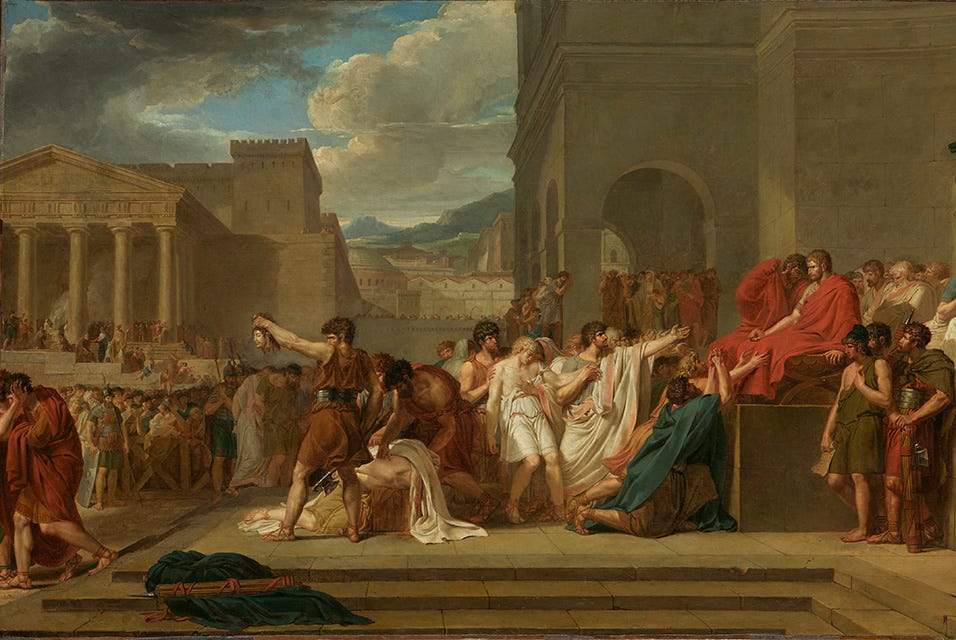
One of the most celebrated Roman virtues was sacrificing oneself for the state. The model citizen was someone who gave up everything to fight for Rome. This is captured vividly in the legend of Lucius Junius Brutus, the first consul and founder of the Republic, who condemned his own sons to death for conspiring against it. He watched them be tortured and executed for treason, a statement that the Republic was the highest good and no one stood above its laws.
This belief does align with the fascist idea of nationalism.
3. Total control
Unlike in fascist doctrine, the Roman state did not control every aspect of life.
Citizens worked as they were able, grew what they needed, and if they had the means read the philosophers they liked and hired the tutors they chose. Rome was a state of free men, and it made no serious attempt to control every dimension of its citizens’ lives.
4. Corporatist economy
Neither the Roman Republic nor the Empire had a clear economic policy in the modern sense.
People held private property and were not required to meet state-imposed quotas. If anything, the Roman economy leaned closer to a free market, with some notable exceptions around non-citizens. It was closer to capitalism with symptoms of oligarchy than anything resembling a corporatist system.
5. Militarism & violence
Rome saw itself as a beacon of civilization and sought to spread it across the known world.
It also believed that empire was necessary to protect the state, secure resources, and maintain the army. Rome took Carthage after it threatened Roman territory. Trajan took Dacia for its gold. And so on.
Rome was exceptionally good at war and used it to subjugate neighbors and secure its interests. But it’s worth noting that warfare was a common feature of nearly every civilization of the era, not a Roman peculiarity.
6. Rejection of democracy & equality
Even after Augustus became princeps, elections were still held in Rome. Every citizen had the right to vote. Rome was considered to belong to the people, it was the people who gave Rome its legitimacy, and they were regarded as its true owners.
This democracy wasn’t always effective, and it steadily lost power over time. But it remained a core idea in the Roman world, surviving even into the Middle Ages.
7. Propaganda & cult of the leader
Rome did use propaganda, most notably under Augustus.
Historians like Livy were commissioned to write about Roman origins and its wars. Many stories were shaped to serve propagandistic purposes, inspiring patriotism, promoting civic virtue, and casting one side as righteous and the other as corrupt.
Roman emperors were often deified, with monuments and shrines built in their honor. This is something fascism would later borrow directly from Rome.
So Rome shared some features with fascism, but far from all of them. Which raises the question: why do people associate Rome with this ideology at all?
Why We Associate Rome and Fascism
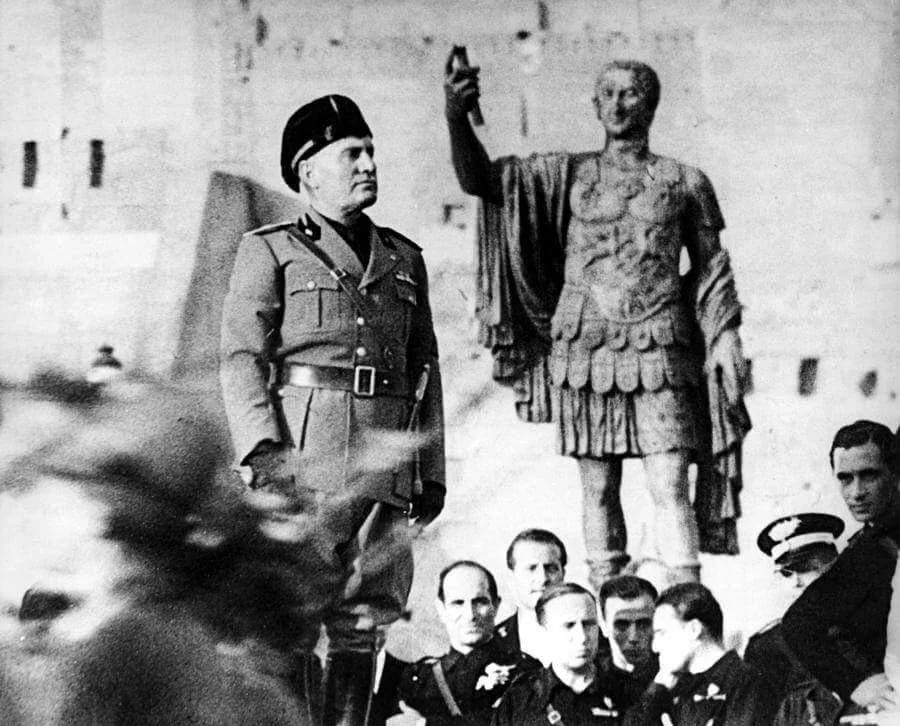
Fascism was inspired by an idealized version of the Roman Empire.
Mussolini took inspiration from ancient Rome, combined it with the popular movements of his time, and forged it into a single ideology. He saw himself as a new Augustus and used every opportunity to link his Italy to that of ancient Rome.
Architecture, art, language, symbols, all of it was borrowed from the Romans. That’s where the association comes from.
We look at the aesthetics and see similarities, even though the ideology differed heavily from anything Rome actually practiced.
It was an ideal that existed in Mussolini’s imagination. He wasn’t interested in accuracy. He took what he felt about Rome and Italy and turned it into a movement that gave people a sense of purpose.
Rome was not a fascist state. It was fascism that tried to be Rome.
— Modern Caesar